Sago palm
Metroxylon sagu
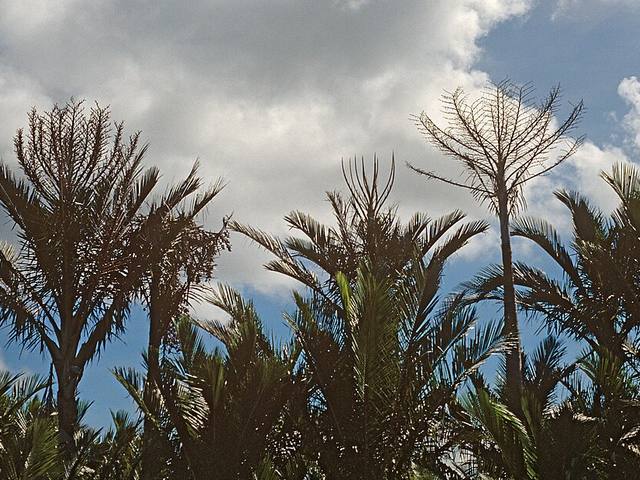
A swamp palm felled once, after 10 to 15 years, for the starch in its trunk: the staple of the Sepik. Each clump keeps sending up new trunks.
Hardiness: zones 11 to 12
Light: full sun
Size: about 35 ft tall, 25 ft wide
Harvest: year-round
From: New Guinea and the Moluccas
Here: Too tender to overwinter outdoors on the Lake Erie shore (zone 6b to 7a): grow it in a pot and bring it in, or treat it as an annual.
Good for: food, wildlife, screens and hedges.
Native to: New Guinea & Melanesia, South & Southeast Asian tropics. Hardy in zones 11 to 12.
The story
Along the Sepik River and in the swamps of lowland New Guinea, sago is the staff of life. A family fells a mature palm, splits the trunk, pounds the pith and washes the starch out in a trough of palm-leaf sheaths, then cooks it into pancakes or a clear jelly eaten with fish and greens. One palm can feed a household for months.
Planting
Full sun in swampy or permanently wet ground, frost-free and hot. Plant suckers from an established clump.
Growing
Very little care: keep the ground wet and thin the suckers so a few trunks grow on. A trunk flowers once and dies, so it is cut just before flowering.
Harvest and use
Harvest a trunk at about 10 to 15 years for its starch; young leaves thatch roofs.
What to watch for
Spiny leaf stalks on some forms. It needs truly wet ground and constant heat.
See if Sago palm fits your yard
Free planner: enter your ZIP for frost dates, climate fit and a sowing calendar. No account, no ads, no tracking cookies.
More tropical and subtropical food plants
General guidance, not professional advice. Conditions vary by yard and year; for local specifics ask your county extension office. Never eat a wild plant you cannot identify with certainty. Traditional uses are shared as history, not medical advice. © 2026 Sean Priest · Irie Orchard. Terms & credits · Privacy · Home