Caraguatá (forest bromeliad)
Bromelia antiacantha
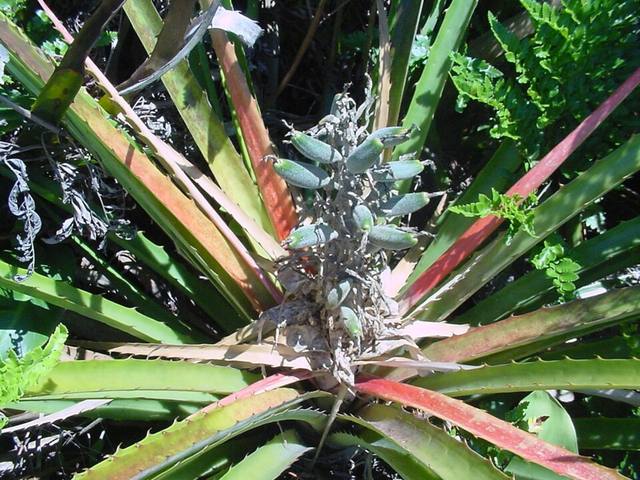
A spiny ground bromeliad: a red-hearted bloom for hummingbirds, then clusters of yellow fruit for syrup.
Hardiness: zones 9 to 11
Light: part shade
Size: about 3 ft tall, 5 ft wide
Harvest: October to January
From: Atlantic Forest, Espírito Santo to Rio Grande do Sul
Drought-hardy once established
Here: Too tender to overwinter outdoors on the Lake Erie shore (zone 6b to 7a): grow it in a pot and bring it in, or treat it as an annual.
Good for: food, pollinators, wildlife.
Native to: Atlantic Forest of Brazil. Hardy in zones 9 to 11.
The story
Caraguatá is a Tupi-Guarani name for spiny bromeliads. In the south its fruit has long been boiled into a syrup for coughs, and the plants were set in rows as living fences.
Planting
Sun or part shade on sandy or rocky, well-drained ground; very tolerant of drought and salt air. Plant offsets.
Growing
Almost no care; it spreads by side shoots into a dense, spiny clump. Wear gloves when dividing.
Harvest and use
After a red-hearted bloom that feeds hummingbirds, clusters of yellow fruit ripen in the cool season; cooked into syrup or jelly.
What to watch for
The leaf spines are fierce, so keep it away from paths and play areas. Raw fruit can irritate the mouth; cook it first.
See if Caraguatá (forest bromeliad) fits your yard
Free planner: enter your ZIP for frost dates, climate fit and a sowing calendar. No account, no ads, no tracking cookies.
More native and wild plants
- Brazilwood (pau-brasil)
- Jatobá-do-cerrado
- Himalayan alder (utis)
- Camellia (tsubaki)
- Azores laurel (louro)
- Azores juniper (cedro-do-mato)
General guidance, not professional advice. Conditions vary by yard and year; for local specifics ask your county extension office. Never eat a wild plant you cannot identify with certainty. Traditional uses are shared as history, not medical advice. © 2026 Sean Priest · Irie Orchard. Terms & credits · Privacy · Home