Dense blazing star
Liatris spicata
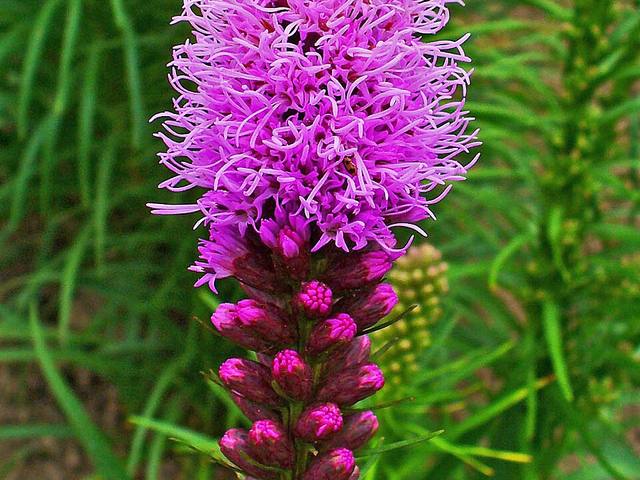
Purple spikes that bloom top down; butterflies queue for it.
Hardiness: zones 3 to 9
Light: full sun
Size: about 3 ft tall, 1.5 ft wide
From: E. North America
Here: Hardy in the Lake Erie shore climate (zone 6b to 7a), so it can live outdoors in the ground.
Good for: pollinators, butterfly and moth caterpillars.
Native to: Northeast, Southeast, Midwest & Great Lakes, Great Plains & Texas, Eastern Canada. Hardy in zones 3 to 9.
The story
Blazing star does something odd: its flower spike opens from the top down, the opposite of nearly every other spike in the garden. It grows from a corm, like a crocus, in wet prairies and meadows.
Planting
Full sun and average to moist soil. Plant the corms in fall or spring, 2 inches deep.
Growing
Stake in rich soil or grow it among grasses that hold it up. Leave the seed heads for goldfinches.
Harvest and use
A top butterfly flower in July and August, especially for monarchs and swallowtails. It is a long-lasting cut flower too.
What to watch for
Voles eat the corms. Wet winter soil rots them.
See if Dense blazing star fits your yard
Free planner: enter your ZIP for frost dates, climate fit and a sowing calendar. No account, no ads, no tracking cookies.
More native and wild plants
- Purple prairie clover
- Wild lupine
- Texas bluebonnet
- California poppy
- Foxglove beardtongue
- Rocky Mountain penstemon
General guidance, not professional advice. Conditions vary by yard and year; for local specifics ask your county extension office. Never eat a wild plant you cannot identify with certainty. Traditional uses are shared as history, not medical advice. © 2026 Sean Priest · Irie Orchard. Terms & credits · Privacy · Home