Black mulberry
Morus nigra
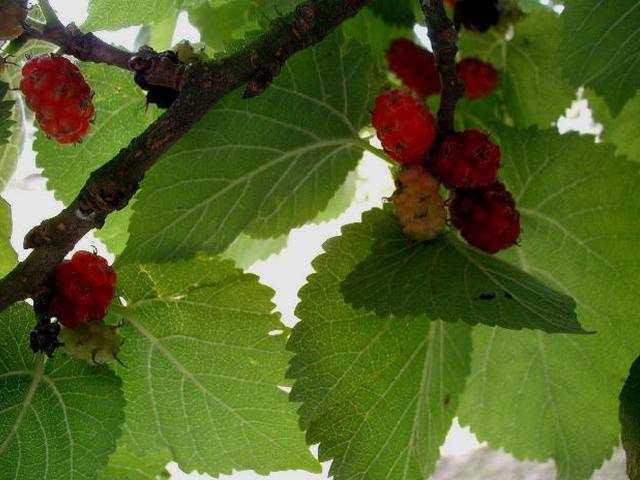
The best-tasting mulberry and the messiest; the trees outlive the people who plant them by centuries.
Hardiness: zones 6 to 9
Light: full sun
Size: about 30 ft tall, 30 ft wide
Harvest: July to August
From: Iran and the Caucasus
Drought-hardy once established
Here: Hardy in the Lake Erie shore climate (zone 6b to 7a), so it can live outdoors in the ground.
Good for: food, wildlife.
Native to: Caucasus. Hardy in zones 6 to 9.
The story
The black mulberry has been grown for so long that nobody is sure where it is wild; the best guess is the mountains south of the Caspian. In 1608 King James I had thousands planted in England to found a silk industry. They were the wrong mulberry, since silkworms want the white one, but the fruit was a fine consolation.
Planting
Full sun, shelter and deep, well-drained soil. Plant it over grass, never over paving.
Growing
Prune only in midwinter; it bleeds sap. It is slow, and it leans and gnarls handsomely with age.
Harvest and use
Ripe in late summer. Spread a sheet and shake the branches. The juice is rich, sharp and sweet at once, for eating fresh, sorbet and syrup.
What to watch for
The juice stains hands, clothes and patios purple. Birds.
See if Black mulberry fits your yard
Free planner: enter your ZIP for frost dates, climate fit and a sowing calendar. No account, no ads, no tracking cookies.
More fruit trees
- Caucasian pear
- Mehal (Himalayan wild pear)
- Lapsi (Nepali hog plum)
- Quandong (desert peach)
- Desert lime
- Sandpaper fig
General guidance, not professional advice. Conditions vary by yard and year; for local specifics ask your county extension office. Never eat a wild plant you cannot identify with certainty. Traditional uses are shared as history, not medical advice. © 2026 Sean Priest · Irie Orchard. Terms & credits · Privacy · Home