Saguaro
Carnegiea gigantea
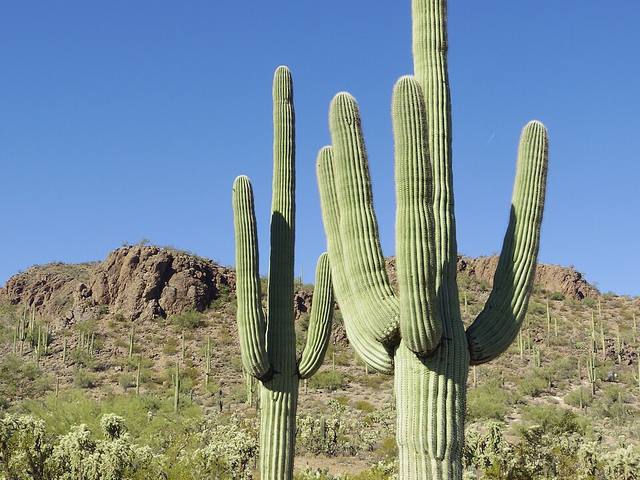
Grows painfully slowly, often 60 years or more before its first arm; the June fruit splits open red and sweet.
Hardiness: zones 9 to 11
Light: full sun
Size: about 40 ft tall, 10 ft wide
Harvest: June to July
From: Sonoran Desert
Drought-hardy once established
Here: Too tender to overwinter outdoors on the Lake Erie shore (zone 6b to 7a): grow it in a pot and bring it in, or treat it as an annual.
Good for: food, pollinators, wildlife.
Native to: Desert Southwest. Hardy in zones 9 to 11.
The story
The saguaro grows wild only in the Sonoran Desert, and its white blossom is Arizona's state wildflower. Each June, Tohono O'odham families camp out to harvest the fruit (bahidaj) with long poles made from the ribs of dead saguaros, and cook it down into syrup; the harvest marks the start of the O'odham new year and the prayers for the summer rains.
Planting
Buy nursery-grown plants only; never dig one from the wild (in Arizona moving a saguaro needs a permit and tag). Plant in warm weather in fast-draining, gravelly soil, keeping the same side facing south as at the nursery. Young saguaros start life in the shade of a nurse tree such as mesquite or palo verde, so plant a small one under its edge.
Growing
Water lightly through the first summer, then let the rain do the work. Expect an inch or two of growth a year while young. Hard frosts below about 20°F that last all night can kill the growing tip, so it is a plant for zone 9 and warmer.
Harvest and use
Night-blooming flowers open in May and feed bats, bees and white-winged doves. The fruit ripens in June and July and splits open red; knock it down with a pole, scoop out the pulp, and simmer it into syrup or jam. The tiny black seeds are eaten too.
What to watch for
Too much water causes rot; frost damage at the top; sunburn if a transplant is turned around; bacterial rot where the skin is wounded.
See if Saguaro fits your yard
Free planner: enter your ZIP for frost dates, climate fit and a sowing calendar. No account, no ads, no tracking cookies.
More native and wild plants
- Prairie turnip (tipsin)
- Sundari (mangrove)
- Wild date palm (khejur)
- Coral tree (mulungu-do-litoral)
- Caraguatá (forest bromeliad)
- Brazilwood (pau-brasil)
General guidance, not professional advice. Conditions vary by yard and year; for local specifics ask your county extension office. Never eat a wild plant you cannot identify with certainty. Traditional uses are shared as history, not medical advice. © 2026 Sean Priest · Irie Orchard. Terms & credits · Privacy · Home